Summer is here and people are hitting the road to enjoy some rest and relaxation — and maybe even some cultural enrichment. What’s your idea of a perfect vacation? If you’ve experienced one — tell us about it in a poem or flash fiction (200 words or fewer). Or if you’re still waiting for your dream sojourn, let us know what you envision — in a poem or flash fiction. If you’ve experienced a less-than-perfect vacation, we’d like to hear about that, too!
PROMPT: In a poem or flash fiction (200 words or fewer), tell us about your perfect or less-than-perfect vacation. Please send a photo of yourself — at any age — to accompany the poem, and provide a caption for the photo (when, where). (If possible, send a vacation photo.)
WHAT: Submissions can be original or previously published poems or flash fiction. You retain all rights to your…
This year we are celebrating the 70th Anniversary of the end of World War Two. It was such a long time ago. I’m trying to remember what it was like for me in those turbulent years of War, and what it was like for my father as a POW in Germany. It will be part of our Family History. From time to time I might post an extract on my blog. It’s a work in progress. So here is Part 2.
You can read Part 1 here, if you wish, and Part 2 here.
Part 3 – Bregana
The only travelling my mother and I undertook in those days of war was to the farm in Bregana. Once, when we were on the bus, she suddenly put her hand over my eyes, saying nothing. It was too late – I saw bodies hanging from the trees, like limp scarecrows. Fear silently crept into my young soul.
In spite of the war and my father being absent, I was happy in Bregana. My mother let me stay on the farm during school holidays. Aunty Zora was her good friend and the same age as my mother, and her daughter Nada was the same age as I. Nada’s little brother was four years younger. Their father, Uncle Pepi, was also an innkeeper and hunter. The whole household, with maids, cooks and farmhands, accepted me as one of their own. I was made to feel at home by so much kindness that I would come to consider their place as my second home.
And what a charming home it was with so many farm animals! Horses, cows, pigs, chickens, geese, ducks, pigeons, a goat and, of course, cats and dogs. You could never be bored, there was so much going on, so much to explore. We even had a go at milking a cow, but it proved too difficult for our small fingers. Still, a cup of fresh milk was ours to enjoy right there, when the maid finished milking. Collecting freshly laid eggs and feeding the chickens was a much easier task.
Our daily round of the farmyard provided a special thrill when there was a new-born calf on its wobbly legs or a foal in the stable, and in the pigsty a sow with tiny, pinkish, squealing piglets lined up along her belly, suckling eagerly, their mother uttering a soft grunt of satisfaction from time to time. Behind the pigsty was a mulberry tree, next to a stinky cesspool, but the mulberries were too yummy to be bypassed because of the stench. There were three orchards surrounding the farm house and the inn, and a garden with a bee house and a raspberry hedge which was regularly plundered by us. The cherry tree and the pear tree didn’t fare any better because climbing a tree was a cinch.
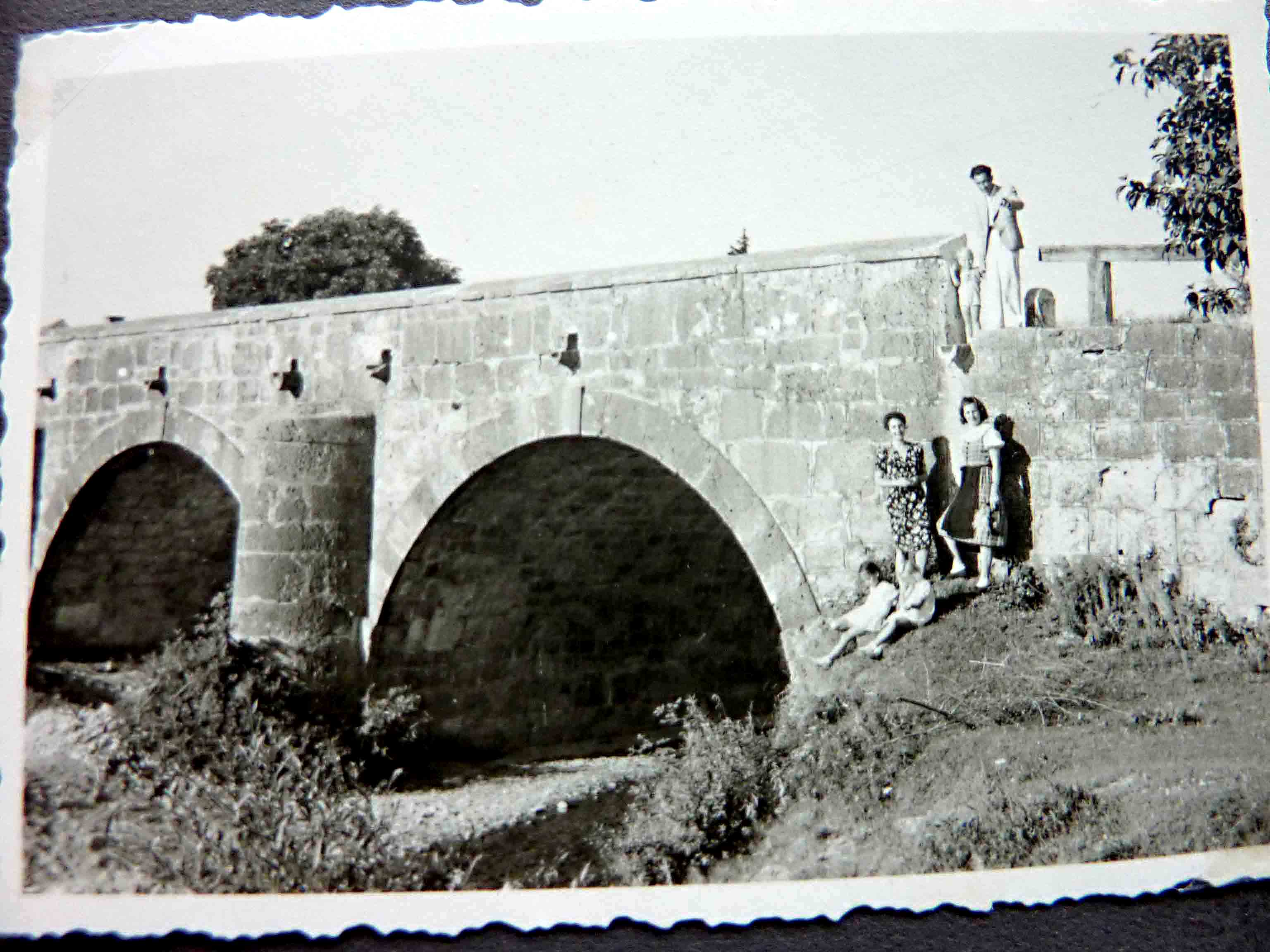
A very special place for us was in no man’s land: a crystal clear stream, Bregana, flowing under the bridge which to this day connects Slovenia with Croatia. Our summer paradise. We could spend hours there wading in ankle-deep water, collecting pebbles of all colours, building dams and pools, sailing paper boats or boats made of half a walnut shell, and even spear-fishing with a table fork.
This bridge connects Slovenia with Croatia
In winter we wanted snow. Plenty of snow. There was no end to fun in the snow, from snowball fights and building a snowman, and a bunker since it was wartime, to skiing and sledding. We usually returned home half frozen and wet, but a change of clothes and a hearty meal revived us and we were ready to settle down near the fire for a game of cards or a board game. Not only did we have good clothing and plenty of delicious food, but we were also showered with love by everyone. No wonder Bregana is the place my old soul wanders to when it needs refreshment.
But I also remember poverty and cruelty. I remember poor peasant children in rags and barefoot. I remember the smell of fresh blood when the door of the slaughter house opened wide, revealing the carcass of the crucified animal. I remember the squealing pig being dragged into the execution chamber. I remember the little kittens were always drowned, although we never saw it done.
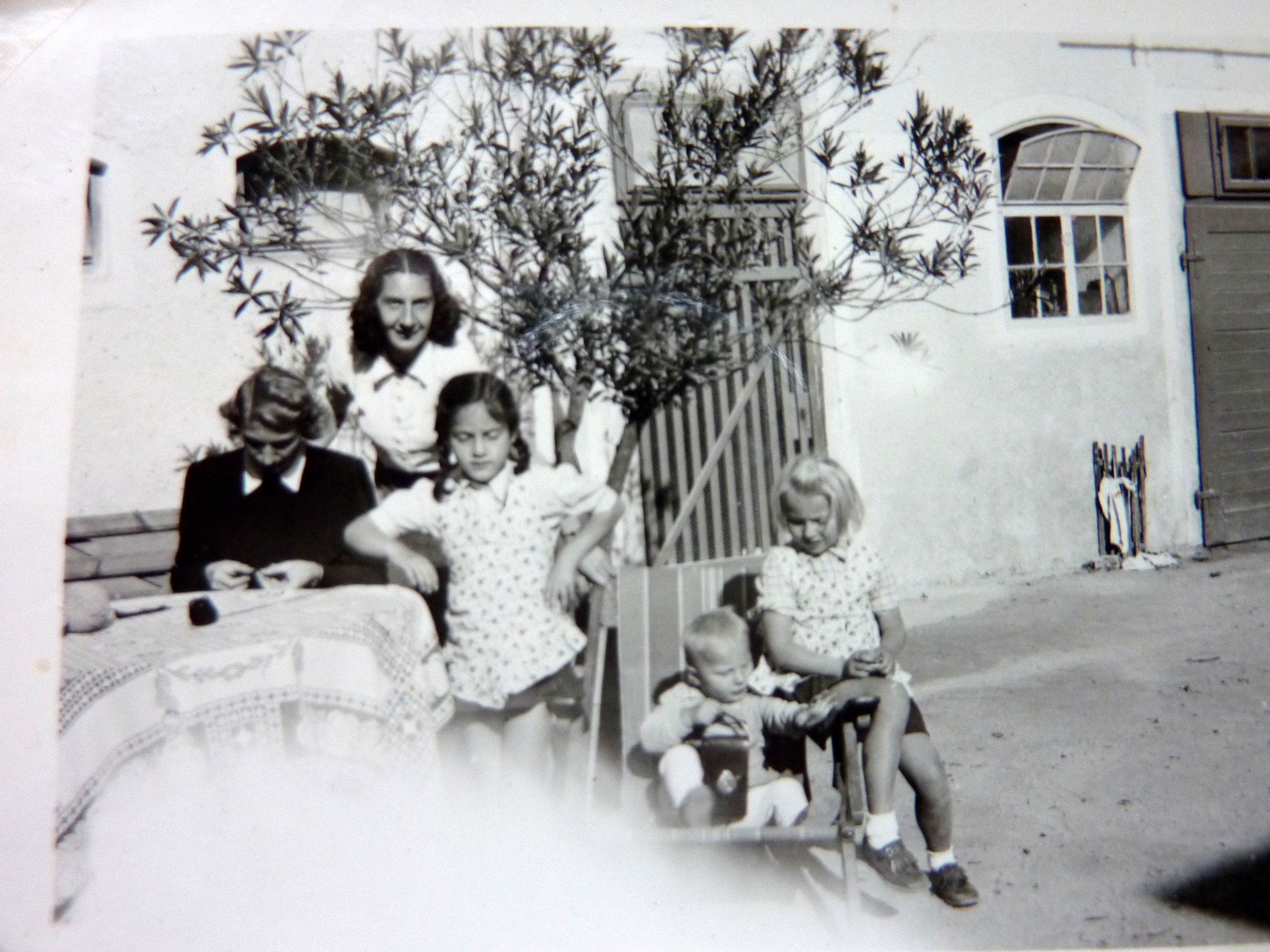
On the farm with our mothers
The Germans occupied parts of the farm. Soldiers were milling around all the time. A few higher ranking officers, fortunately not the dreaded SS, lived in spare rooms in the family home and they would sometimes join us in the living room for a chat. Aunty Zora had a beautiful voice. She would sing Slovenian songs and German ones as well, and we would sing along. I remember well singing Lili Marlene. I didn’t know then that this song was popular with soldiers of both sides. Vera Lynn and Edith Piaf, both as popular as Marlene Dietrich, sang it in English. But I knew it only in German. It’s a love song.
“Written as a poem in 1915, during World War I, it was published under the title “Das Lied eines jungen Soldaten auf der Wacht” (German for “The Song of a Young Soldier on Watch”) in 1937 and was first recorded by Lale Andersen in 1939 under the title “Das Mädchen unter der Laterne” (“The Girl under the Lantern”).” Wikipedia
Here it is for your enjoyment. You can sing along, if you wish, and if you don’t know German, you can hum!
Or you can sing along with Vera Lynn, who sings like a nightingale. This song will warm your heart as it warmed the hearts of soldiers far away from home.
*
Towards the end of the war, both my mother and Aunty Zora were helping the partisans. The Germans didn’t know, of course. One officer, however, did know. But he obviously wasn’t a Nazi because he offered to escort them to the flour mill where they would leave a parcel with medications in a special spot for the partisans to pick up during the night. Without his protection they would not have been able to accomplish these dangerous tasks – German soldiers were everywhere. I wonder why he had put his own life on the line. Did he hate Hitler’s Third Reich right from the start? Was he sick of war? Was he in love with Aunty Zora? The lucky thing was that no one among the Germans had found out about his clandestine activities. Lucky for him and lucky for our brave mothers! After the war, the kind officer, Jul Wanemacher, naturally, was always a welcome guest in Bregana.
~A triolet (/ˈtraɪ.əlɨt/ or US /ˌtriː.əˈleɪ/) is a stanza poem of eight lines. Its rhyme scheme is ABaAabAB and often all lines are in iambic tetrameter: the first, fourth and seventh lines are identical, as are the second and final lines, thereby making the initial and final couplets identical as well. (Wikipedia)
On 25th April, the day of the landings at Gallipoli, I want to remember the young volunteers from Australia and New Zealand who put their lives on the line to fight the brave fight a hundred years ago. My father, Bogdan Stojić, was a volunteer, too. He served as a medical orderly in the Serbian Army at the time.
The poem in this post is dedicated to the heroes of both World Wars as well as those in present wars, as, unfortunately, humans have not yet found a way to resolve conflicts without the use of arms. The poem was written for Susan Budig’s Mindful Poetry Contest 2012. It was first published by narratorAUSTRALIA (now narratorINTERNATIONAL) online and in print in narratorAUSTRALIA, Volume Two. It also appears in my book Dreams On My Pillow.
The Anzac March
Decuain
My Muse, oh please help me write a poem
In thoughts I see the bloody battlefields
Anzac Marchers proud and very solemn
The battling soldier heartfelt prayer shields
He fights against the wicked, never yields
Returns per chance a hero, shell-shocked, maimed
Or killed, the stuff that always wartime wields
Blood and tears are shed, victor is proclaimed
See the medals, hear the bagpipe’s rhythm
Cheers to all who fought for sacred freedom
~
The decuain is a ten-line rhyming form in iambic pentameter created by Shelley A. Cephas.The rhyming pattern in this decuain is: ababbcbcaa.
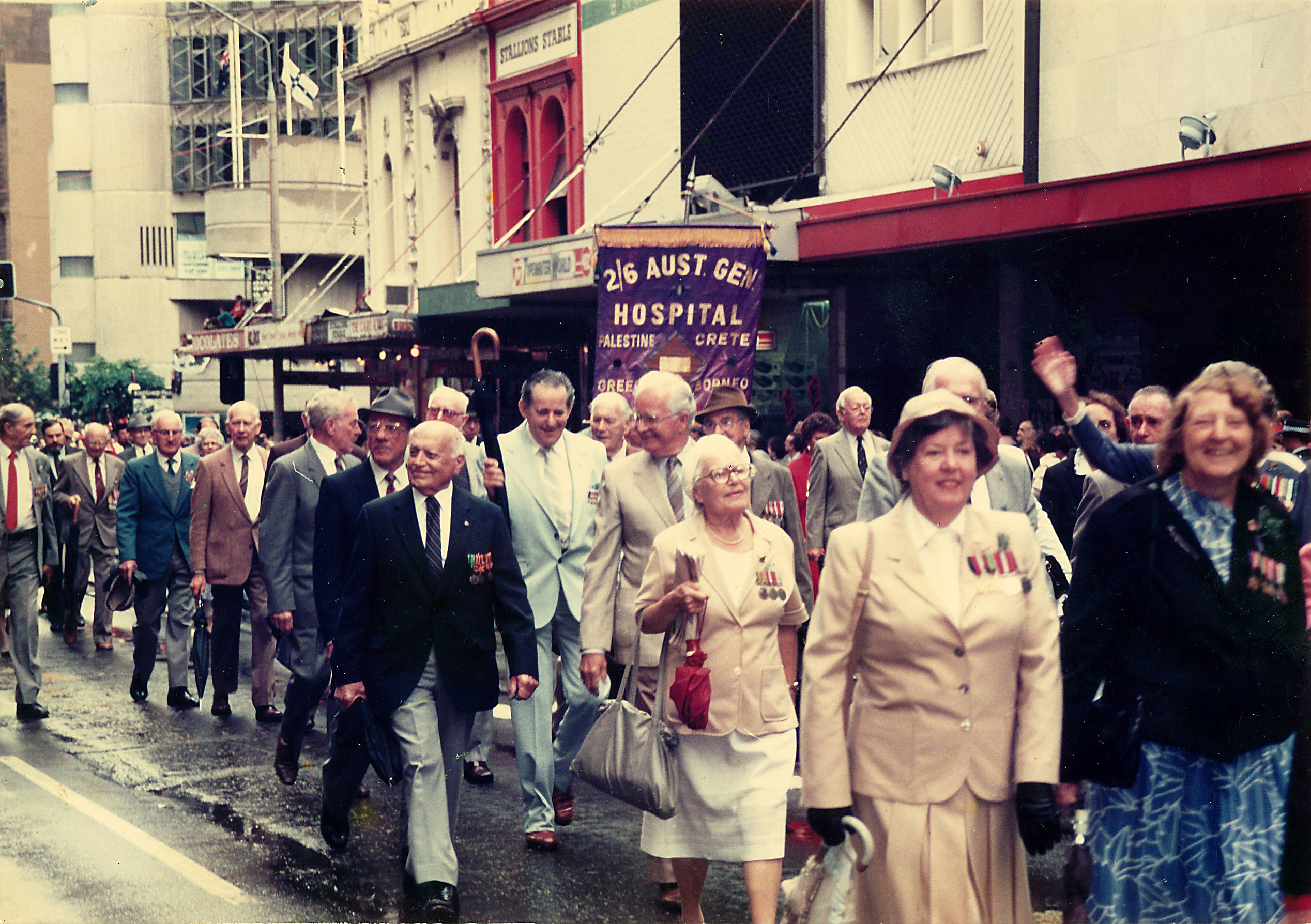
My father always marched with Frank Hebbard, his POW camp mate in WWII, under the 2/6 Australian General Hospital banner. He is the marcher smiling at us, wearing a blue jacket with his medals for bravery.
My father, Dr Bogdan Stojić, who was Lieutanant-Colonel in reserve in the Yugoslav Army, with Mum and me after completing the Anzac March in Sydney in 1988, aged 95.
~
They shall grow not old, as we that are left grow old:
Age shall not weary them, nor the years condemn.
At the going down of the sun and in the morning,
We will remember them.
When I was nine years old, the war was on.
The enemy drowning fast at last; the end
Was near, but first the Allies had to bomb
Our town to drive the fiend aground, and so
We hid below in shelters, praying loud
While bombs were shaking walls and breaking hearts
And windows; I was always first to grab
My bag with sugar when the siren howled,
Then ran as fast as arrow; sheltered well
Beneath, I thought; the drone of bombers near,
Then whizz through air, then once again, three times
Before the end — the siren shrilling flat.
AUTHOR’S NOTE ON THE PHOTOGRAPH: With my mother during WWII. This photo was sent to my father, a POW in Lamsdorf, Germany.
NOTE FROM THE AUTHOR: I chose this poem as this year we are celebrating the 70th anniversary of the end of…
This year we are celebrating the 70th Anniversary of the end of World War Two. It was such a long time ago. I’m trying to remember what it was like for me in those turbulent years of War, and what it was like for my father as a POW in Germany. It will be part of our Family History. From time to time I might post an extract on my blog. It’s a work in progress. So here is Part 2.
My only two cousins left for Ljubljana in Slovenia to stay with our grandparents. It was safer for their family there. Yugoslavia was falling apart under the onslaught of the Axis: Slovenia, south of the Sava River, came under Italian occupation while the Nazis ruled in my neck of the woods, helped by home-grown collaborators. My mother and I sought refuge on our friend’s farm in Bregana, on the border of Slovenia and Croatia, not far from Zagreb. It was safer for us there, too, in those turbulent first days of occupation. We stayed in Bregana for three months.
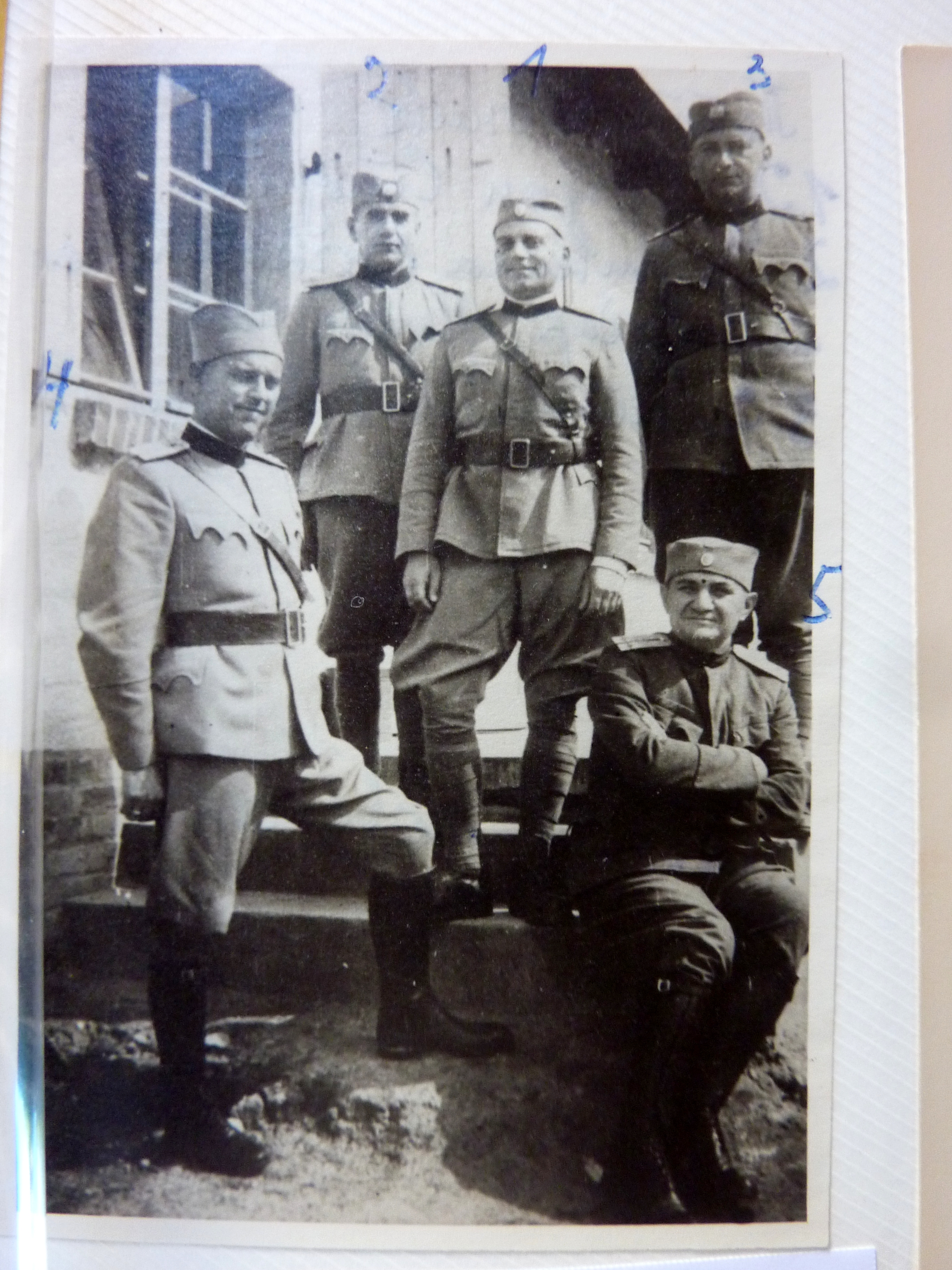
Meanwhile, my dad, a doctor and lieutenant-colonel in reserve was captured in Bosnia by the Germans on 15 of April 1941 and transported in cattle trucks with other POWs to Germany. My mother must have given a sigh of relief when she received in November his first letter and a photo from Teschen in Upper Silesia, now Tešin in the Czech Republic.
.
My father is in the middle
The first two years of occupation were relatively peaceful both in my hometown and in Bregana on the farm. I started primary school in 1942. It was run by Catholic nuns. I liked my school. I was a good, obedient pupil, and I adored our teacher, Sister Irma. She had a sweet smile and loved me, too, I think because I was a very devout little girl.
I’m the girl with dark plaits in front of Sister Irma, on the right.
Wasn’t Sister Irma pretty? She was young, with a freckled face and when she smiled, I thought she looked like an angel. I wanted to be like her. I wanted to become a nun. A teaching nun, just like Sister Irma. But ballet came in the way. I went to ballet classes with my best friend, Ines. The two of us would become inseparable. We both loved ballet and often performed together. I was happiest in the ballet class. Even happier on stage. In my first performance I was one of the little chickens in Mussorgsky’s ‘Pictures at the Exhibition’. Our teacher, Ana Maletić, ran the best school of modern ballet in Zagreb in Mesnička Street and was a marvellous choreographer. All her students, the very young, like me, and older girls, took part in all ballet performances. For this particular “tableau”, the ‘Ballet of the Unhatched Chicks’, she envisaged the little chicks all in yellow, with yellow socks, so we were asked to dye a pair of white socks ‘little-chick yellow’. But our mothers, Ines’ and mine, objected: they were not prepared to ruin a pair of white socks we needed for school. Oh, how embarrassed we both felt? And disappointed. The other mothers were quite willing to go ahead with the dying, but our mothers were adamant, not willing to change their position. Well, it was decided then that all the little chicks would dance barefoot, which we didn’t mind at all. Mother Hen was an older student. When the curtain went up Mother Hen stood in the middle of the stage, dressed in a large crinoline of feathers under which we, the little chicks, were hiding. Slowly and cautiously the first chick appeared; then the second one, and the third, and so on until all six hatched one by one and were out dancing in a circle around Mother Hen’s crinoline. Then she taught us how to look for worms in the ground, so we scratched the ground with our bare little chicken feet. Next, she taught us how to use our wings to fly, but at the sight of an eagle, she called us back to hide under her feathers. Oh, what delightful fun! I can still dance parts of the routine. But I need the music.
And here is the original piano version. Embedding was disabled by request, but I’m including the link because we danced to the piano version, played by the very talented Mr Marasovic, our regular pianist.
Mussorgsky – Pictures at an Exhibition (original piano version)
Many performances followed. In a German tale for children ‘Der Struwwelpeter’, ‘Stockhead Peter’ or ‘Janko Raščupanko’ in Croatian, I was a comb and Ines was a bar of soap. And another friend, Vesna Kobelja, was a cat. In our ballet class we had to learn each other’s roles and, of course, I still remember some of the steps. The greatest thrill and pleasure was to dance on stage. I never had the slightest stage fright. I knew my steps well and looked forward to appearing from behind the curtain to perform. When I was the comb and finished my dance hopping into the “drawer” behind the curtain, Ana Maletić was there with a beaming face; she hugged me and kissed me on the cheek, and I knew that I did well.
*
In ‘Petrica Kerempuh’, based on ‘The Ballads of Petrica Kerempuh’ by Croatian writer Miroslav Krleža, I was a little girl playing with my brother, a girl who was of stronger build than me. We followed our mother, a poor peasant, throwing an apple to each other as we danced, which was a bit tricky, but we managed to finish our dance without dropping our “ball”.
The performances were staged in The Little Theatre, as it was called then, in Frankopanska Sreet. Today it bears the name of the Croatian theatre director, critic and essayist Branko Gavella – Gavella Drama Theatre, opposite the church where I worshipped with the nuns and lovely Sister Irma. Ines and I loved pretending to be nuns and teachers. I had a little altar in my room with the figure of the Virgin Mary, and whenever I passed by, I would genuflect and cross myself.
‘So which way will I go? Will I be a nun or a dancer?’ I was torn between those two vocations.
My poem ‘Sing A Song of Love When The Warlock Beckons’ has just been published by narratorINTERNATIONAL. If you wish, you can support me there. It’s a very friendly publishing company; you may even consider submitting your work.


 Summer is here and people are hitting the road to enjoy some rest and relaxation — and maybe even some cultural enrichment. What’s your idea of a perfect vacation? If you’ve experienced one — tell us about it in a poem or flash fiction (200 words or fewer). Or if you’re still waiting for your dream sojourn, let us know what you envision — in a poem or flash fiction. If you’ve experienced a less-than-perfect vacation, we’d like to hear about that, too!










 Irina's Poetry Corner